
Free tool for bands
Check your tour routing
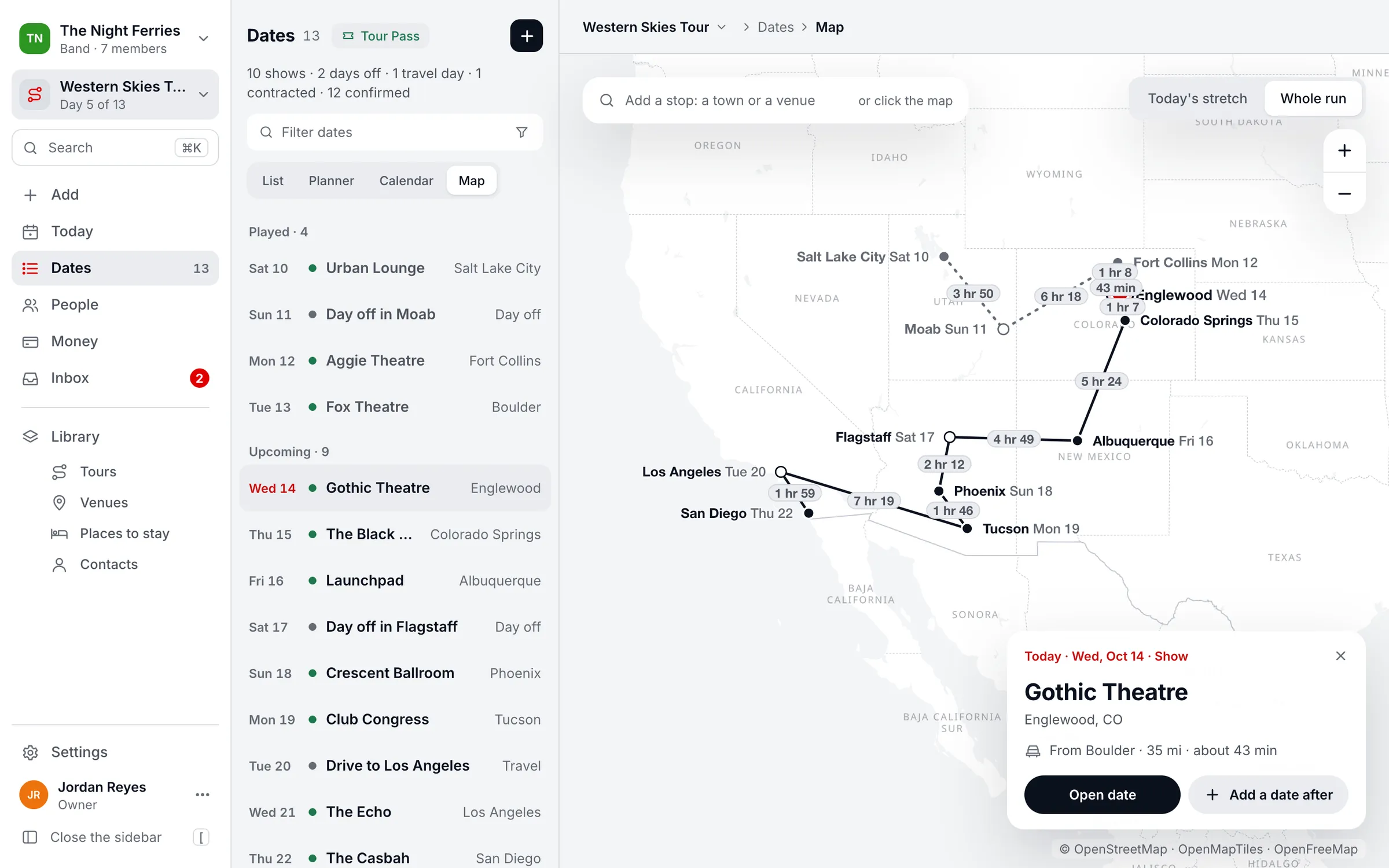
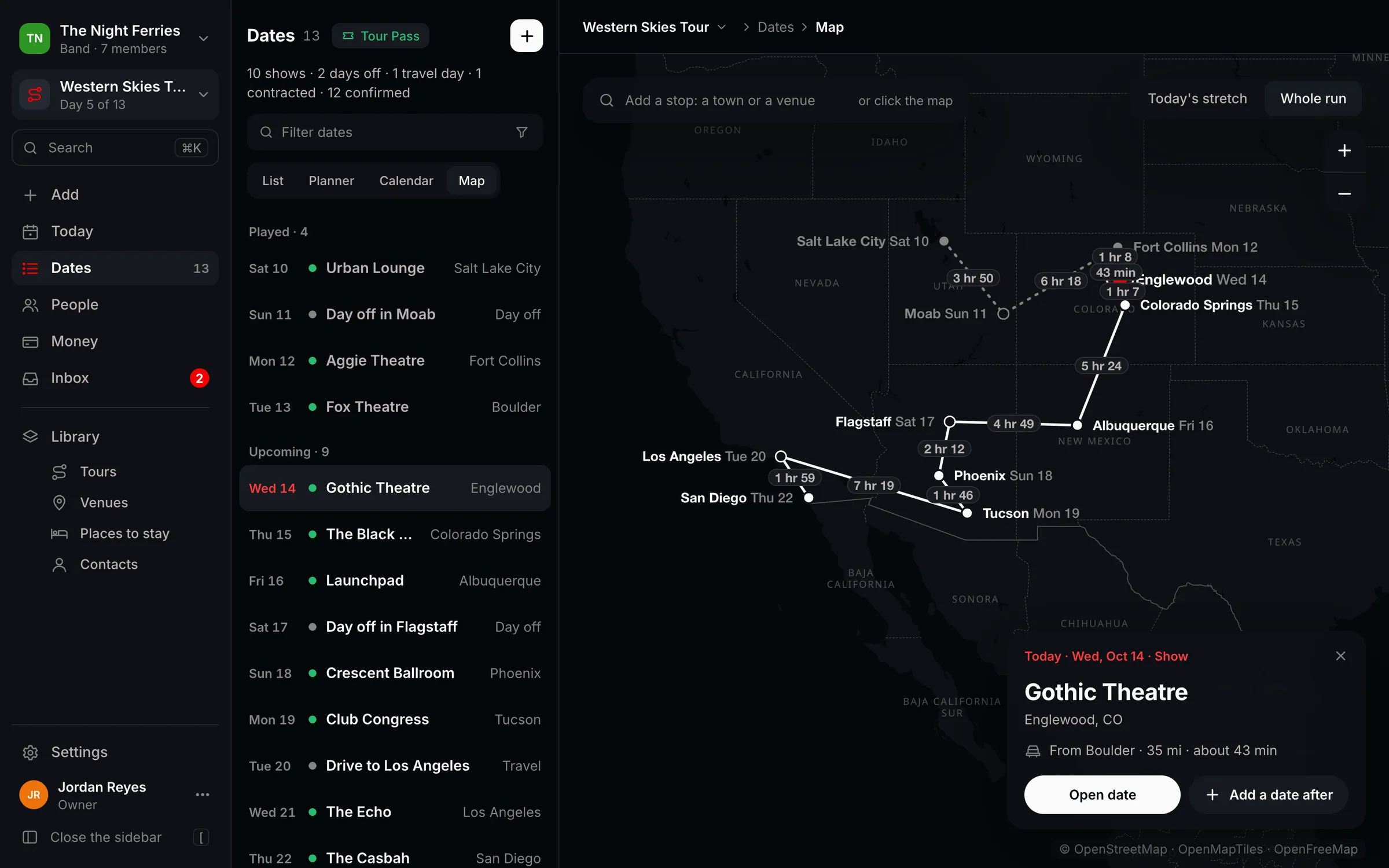
Routing is the order you play your towns in. Paste your dates and see the run on a map: every drive between shows, the ones that are too long, and where it doubles back. Then drag a town to another night and watch the miles change. No account.
Check a run
- No account, no limit
- The same map as the Tourouter app
- Drag a town to another night
- Up to four versions, side by side
- 1,700+ US and Canadian towns
- Saved in your browser. Nothing is uploaded
What it checks
Four things that are cheap to fix before a date is confirmed and expensive after.
Drives over your limit
Set the longest drive you want in a day. A drive over it is flagged only when there is no day off before you leave or after you arrive. A long haul with a day off behind it is a plan, not a mistake.
Doubling back
When a drive heads back the way the last one came, it says so. Playing the nearer town first is often one email to a promoter, and it is far easier to ask before the date is confirmed.
What this order costs
It works out the order of the same towns that drives least, and tells you the miles and hours between that and yours. One press tries it, beside the run you came with.
Miles, hours and gas
The whole run added up: shows, days off, miles, hours behind the wheel, and gas at your van's miles a gallon. A bar for each night's drive shows where the hard stretch is.
Try it another way
"What if we played Salt Lake first" is a drag, not an afternoon with an atlas.
Drag a town to another night
The dates stay where they are and the towns move between them. Every drive, the total and the map change as you go. On a phone, each row has arrows.
Keep up to four versions
Copy the run and change the copy. The versions sit side by side with their miles, hours and warnings, and the one that drives least says so.
Take anything back
Undo steps back through whatever you moved. What you paste and what you drag are the same lines, so the box always shows the run as it stands.
See how far one drive gets you
Press a stop on the map. A ring shows about how far your longest drive reaches from there, and the towns inside it. Press one and it goes in as the next night.
Lock the nights that cannot move
The festival slot and the hometown show stay where they are. The shorter order is worked out around every night you lock.
Find a town for an open night
A day off, or a gap between two dates, gets a short list of towns you can reach from the show before and still make the show after. The least out of the way come first.
How to route a tour
For the band member who ended up booking the run. Tash Cox, who books her own band's tours and hosts our podcast, writes about how she does it in Tour Chess.
- 01
Start with the dates that cannot move
A festival slot, a hometown show, a weekend in the biggest city on the run. Put those down first. Everything else is routed around them.
- 02
Fill the days between with towns on the way
Look at the map between two fixed dates and book what sits on the road from one to the other. A weeknight show two hours off the route costs four hours of driving.
- 03
Agree on the longest drive
Every band has a number. Settle it before you book, because a drive on a show day has to end before load in and somebody has to do it again tomorrow.
- 04
Put the days off where the long drives are
If one haul has to be long, leave the day before or the day after it empty. A day off in the right place fixes a drive that no amount of leaving early will.
- 05
Check the shape before you confirm
A routing can look fine as a list and be wrong on a map. Paste it in above while the dates are still holds, when moving one is still a question and not a cancellation.
After the check
The same run, as a tour the whole band can open
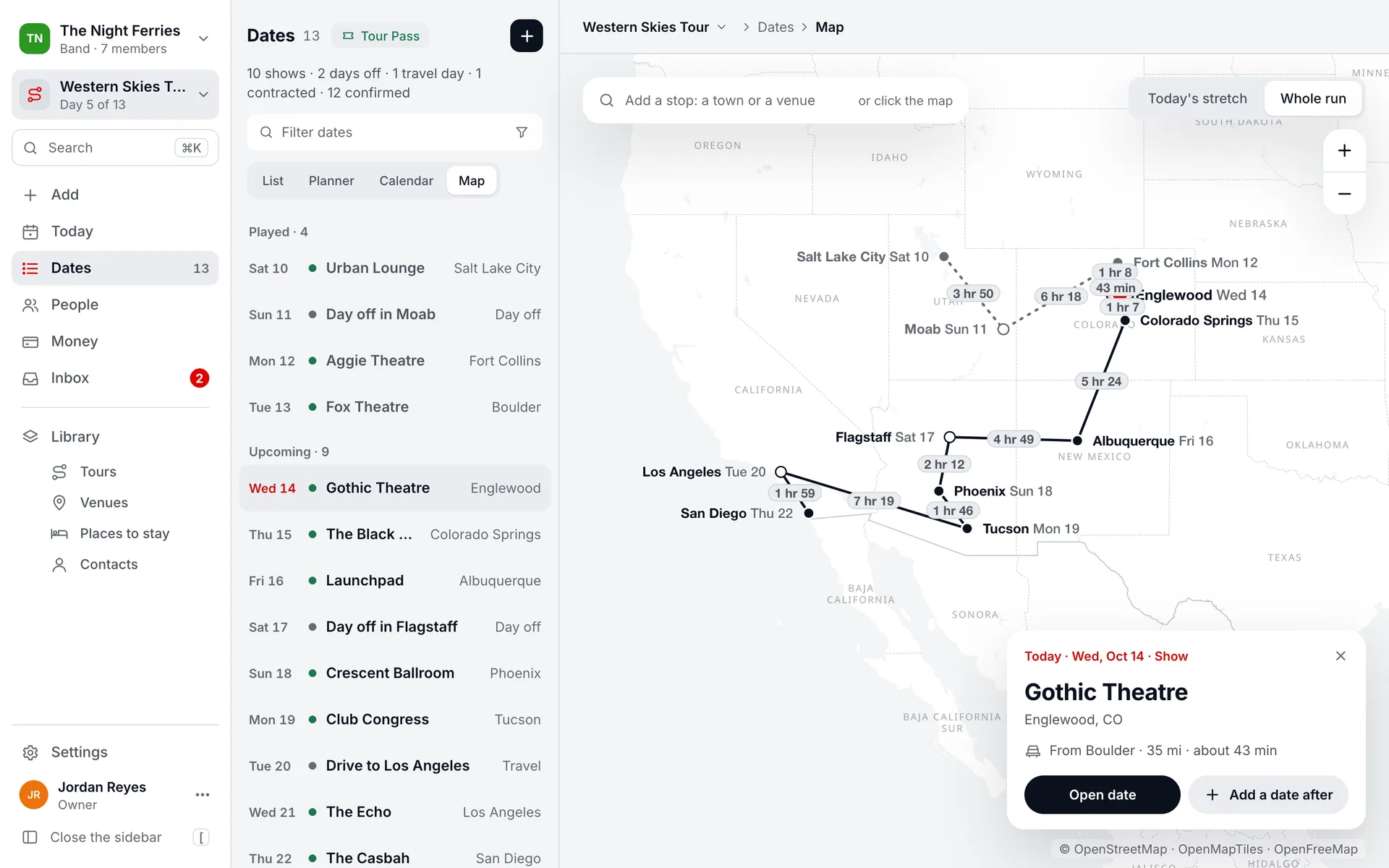
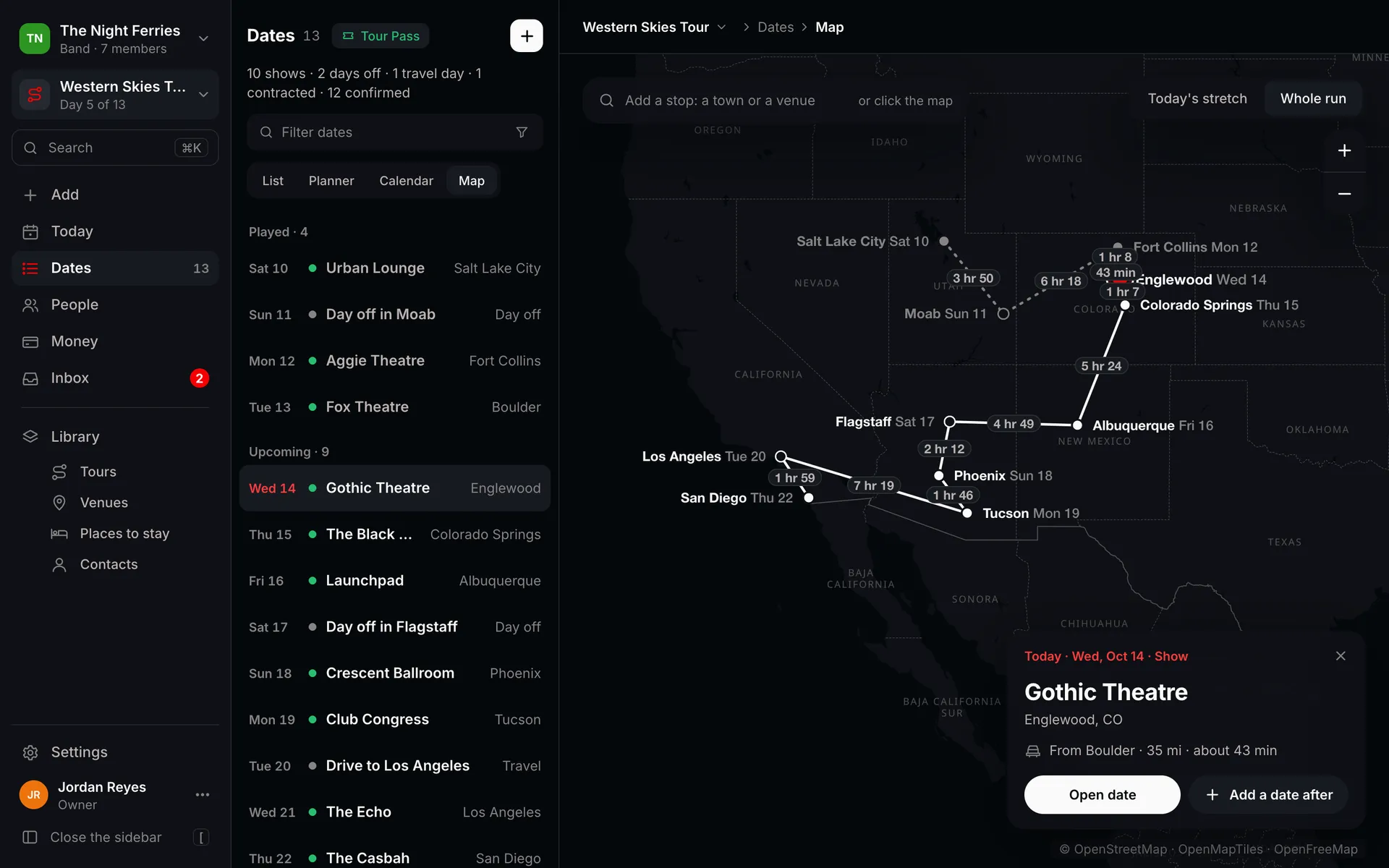
The check draws straight lines and estimates the time. In Tourouter the dates become a tour: every drive is measured on the road, the tour routing sits on the same map with the measured drive time on each leg, and each date gets a day sheet that goes to the band by text every morning. Planning is free.
Routing questions
Planning the shows as well as the drives? The day sheet template and the stage plot maker are free too.
What is tour routing?
Routing is the order a tour plays its towns in, and the drives that order makes. Good routing keeps each drive short enough to load in on time, puts days off where the long drives are, and avoids driving the same road twice.
How long should a drive between shows be?
There is no one number, and bands who tour a lot land in different places. One band on our podcast caps every drive at five hours. Tash, who hosts it, says her own band will do eight on a show day. What matters is that the band agrees on it before the van leaves. This tool starts at nine hours, the limit Tourouter starts with, and you can set your own.
How accurate are the drive times?
They are estimates. The tool takes the straight-line distance between two towns, adds 18 percent for the road, and counts 65 miles an hour, which is roughly what a maps app works out to between cities. It is furthest off where the road has to go around something: a lake, a bay, a mountain range. It is good enough to spot a drive that is too long, and not good enough to plan a load in by. Tourouter measures the real road once the dates are in a tour.
Does the map show the road we will drive?
No. The map itself is real: it is OpenStreetMap, drawn the way the Tourouter app draws it. The lines between stops are straight. They show the order and the rough distance, not the highway. The ring around a stop is the same kind of estimate: about how far your longest drive reaches. Tourouter measures each drive on the road once the dates are in a tour.
Which towns does it know?
More than 1,700 cities and towns in the United States and Canada. If yours is not on the list it says so and leaves that drive out of the totals, so nothing is ever guessed. Europe, the UK and everywhere else are not in it yet.
Is my routing uploaded anywhere?
No. The dates are read and saved in your browser, on your device. A link you copy for the band, and the one that takes a run to sign-up, carry the dates inside the link itself, in the part a browser never sends to a server. We count how many people use the tool and how many stops a run has, and never the towns, venues or dates. The map's background comes from OpenFreeMap, a public map service: your browser asks it for the part of the map you are looking at, as with any online map. It is never sent your dates, towns or venues.
Is this really free? What's the catch?
It is free, with no account and no limit. Tourouter makes tour management software for bands, and working out the routing is the first thing a band does with it, so we put that part where anyone can use it. If you want the run kept, measured on the road and sent to the band as day sheets, the app is free to plan with too.
Can it plan the route for me?
It finds the order of your towns that drives least and lets you try it in one press, beside the run you came with. Lock the nights that cannot move and it works around them. For an open night it lists towns that fit between the shows on either side. It does not book anything: which nights the rooms are free is between you and the promoters. So it is built for trying things. Drag a town to another night, keep up to four versions, and compare the miles.
What do I do with the run once it checks out?
Press Start planning free under the run. It goes with you: sign up, name your band, and the dates are waiting under Import your dates. You check what Tourouter read, and the tour is made with every date in it.
Route it once. Send it to everyone.
Put the run in Tourouter and the band stops asking what time load in is. The day sheet goes out by text and email each morning, and crew need no app to read it. Free to plan.
Start planning free